
Building an Azure Portfolio: How to Showcase Your Architect Skills
Passing certifications proves knowledge, but getting hired as a Solution Architect requires proof of capability. An Azure portfolio bridges that gap — it demonstrates how you think, design, and document real-world solutions. Recruiters and hiring managers want tangible evidence of architectural reasoning, not just credentials. Here’s how to build a professional Azure portfolio that communicates technical depth and business value.
1. Start with Your Architectural Narrative
Your portfolio should tell a story. Define the type of architectures you’ve designed — whether it’s migration, greenfield SaaS, data modernization, or hybrid networking. Explain your design drivers: scalability, security, governance, performance, or cost. This context helps reviewers understand your decision-making approach rather than just the final diagram.
2. Include Design Artifacts, Not Just Diagrams
Great architects produce documentation that goes beyond visuals. Include critical artifacts such as:
- Architecture Decision Records (ADRs): Brief documents explaining why certain choices were made and what alternatives were rejected.
- Solution Architecture Document (SAD): A concise description of system components, interfaces, dependencies, and NFRs.
- Risk Register: Identifies potential issues in cost, security, or scale with mitigations.
- Architecture Compliance Review Checklist: Validates adherence to best practices or landing zone standards.
Don’t worry if these artifacts start from templates — the key is personalization. Adapt them to the context of each project.
3. Build with Azure Reference Architectures
Use reference patterns from Microsoft Learn or the Azure Architecture Center as the backbone of your examples. Recreate simplified versions of architectures like:
- Hub-Spoke enterprise network
- High-availability web application using App Gateway and VM Scale Sets
- Data ingestion with Event Hubs and Azure Data Lake
- Serverless integration using Functions and Logic Apps
Replace client-specific details with generic components — focus on demonstrating architecture reasoning, not implementation secrets.
4. Visual Consistency and Tooling
Use consistent diagrams across your portfolio. Stick to Azure’s official icon set in draw.io, Visio, or diagrams.net. Each diagram should have a clear title, logical layout (left to right for flows, top to bottom for layers), and labeled zones (App, Data, Security, Governance). Store diagrams in a GitHub repository or Notion workspace so others can view without downloading files.
5. Demonstrate Governance Awareness
Architects stand out when they connect design with enterprise guardrails. Include at least one section in your portfolio where you highlight Azure Policy, cost management, or compliance considerations. For example, mention how your design aligns with Well-Architected Framework principles or how tagging and policy enforcement maintain consistency.
6. Create a Public or Private Portfolio
For public sharing, redact confidential details and focus on architectural logic. Use GitHub Pages, Medium, or your personal site (e.g., yourname.dev) to host case studies and visuals. For private use (interviews), prepare a PDF or PowerPoint version with richer commentary and backup details.
7. Keep It Alive
Update your portfolio quarterly. Add new diagrams, certifications, and projects. Link to blog posts or talks if you publish technical content. Your portfolio should evolve alongside Azure — that demonstrates continuous learning, not static expertise.
Diagram
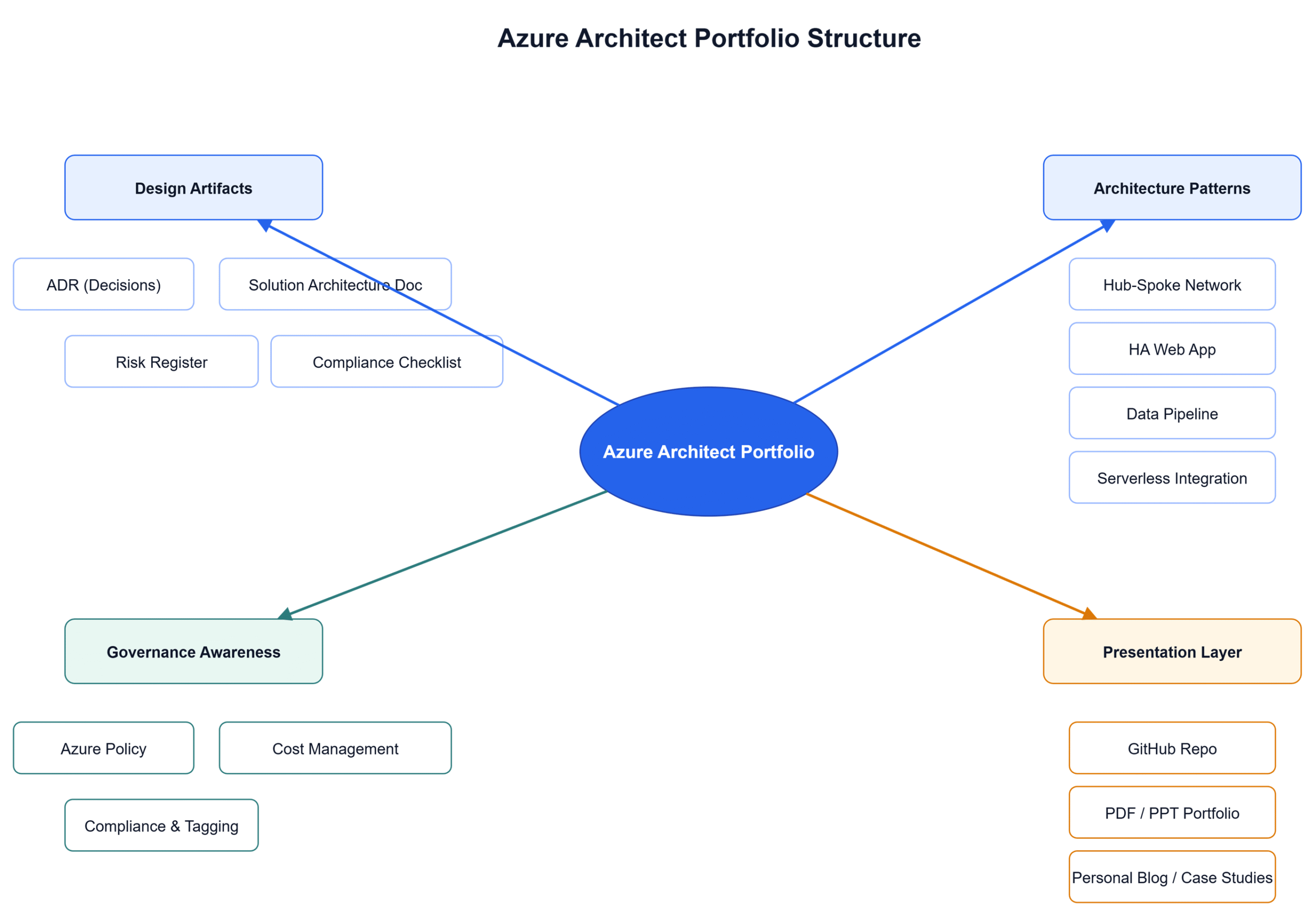
The diagram below shows the structure of an architect’s professional portfolio — connecting Azure reference architectures, governance considerations, and documentation artifacts into one cohesive showcase.
Conclusion
A strong Azure portfolio isn’t a collection of pretty diagrams — it’s a narrative of your architectural maturity. It should convey your ability to balance design trade-offs, apply governance principles, and communicate with both technical and business stakeholders. When you present a portfolio that looks structured, thoughtful, and version-controlled, you don’t just apply for jobs — you prove you’re already thinking like an enterprise architect.